Sports Field Agronomy & Maintenance

We bring more than 15 years of direct turf management experience, specialising in sports field agronomy and the management of high-performance sports surfaces in 12+ states in India. Our expertise ensures best performance in the field. We develop comprehensive sports field maintenance and advisory programs for stadium operators, state sports authorities, elite sports academies, corporate complexes and private athletic clubs wanting world class, player safe turf quality.

GLC offers planning maintenance to environmental solutions to meet any or all of your requirements for

Sports Field Agronomy & Maintenance

  • Safety & Security - Safety Procedures, Fire Safety, Material Safety Data Sheets(MSDS), Hazardous Material, Equipment Safety, Tool Safety, Security
  • Staffing - Personnel Management, Labor Cost Controls, Supervision
  • Staff Training - Appearance Standards-Field SetUp and Maintenance Training, Equipment Training, Chemical Training, Safety Training, SecurityTraining, Environmental Training
  • Maintenance Standards & Goals - Turf Grasses Fields, Pitches, Overrun Areas, Irrigation, Signage, Detail work, Cultural Activites, Chemical Applications, Sand and Seed, Nursery.
  • Agronomic and Water Standards -Fields & Pitches
  • Field Set Up and Maintenance - Field SetUp,Mowing
  • Shop Set Up and Maintenance - Material Stockpiles, Fuel and Chemical Storage, Tools, Equipment, and Machinery, Lighting and Signage
  • Equipment Maintenance - Operation and Care of Equipment, Repair and Maintenance, Tools and Diagnostic Equipment, Maintenance Schedule, Maintenance Records
  • Hazardous Material Management - Storage, Mixing, Application, Fuels, Lubricants, and Solvents

Safety and Security

  • Facility access protocols for security of specialised maintenance equipment and turf chemical storage.
  • Routine screening of playing surface debris and hazards to ensure a safe environment for players.

Staffing

  • Deployment of highly skilled groundsman, machine operators and irrigation technicians on site.
  • Develop and manage full scheduling and staffing based on seasonal and tournament needs.

Staff Training

  • Further in-house training on specialised sports turf mowing patterns, aeration techniques and micro-nutrient calibration.
  • Heavy duty turf equipment machinery safety training and certification.

Maintenance Standards and Objectives

  • Designed performance indicators for the specific sports requirements for optimal ball roll, shear strength and dense root development.
  • Multi-level aesthetics and health to keep presentations-ready pitches year round.

Water and Agronomic Criteria

  • Precision irrigation management for uniformity of subsurface root growth and water efficiency.
  • Watch moisture carefully to avoid waterlogging, local dry spots and fungus problems.

Field Establishment and Maintenance

  • Line marking and preparation of field to governing body international dimensions for game day.
  • Special surface repair, divot filling and sweeping routines after play.

Shop Setup & Maintenance

  • Design of systematic sheds and storage of tools for turf operations.
  • Keeping work areas clean and free of debris to facilitate professional responsibility and clinical safety guidelines.

Maintenance of Equipment

  • Preventive maintenance programs for precision reel mowers, deep tine aerators and top dressers.
  • Regularly sharpen blades and adjust bedknife for clean, untattered grass tips.

Handling Hazardous Materials

  • Bio-rational treatments and fertilisers must be stored, handled and contained according to strict protocols.
  • Safe rinsing and disposal practices and in accordance with local environmental regulations.
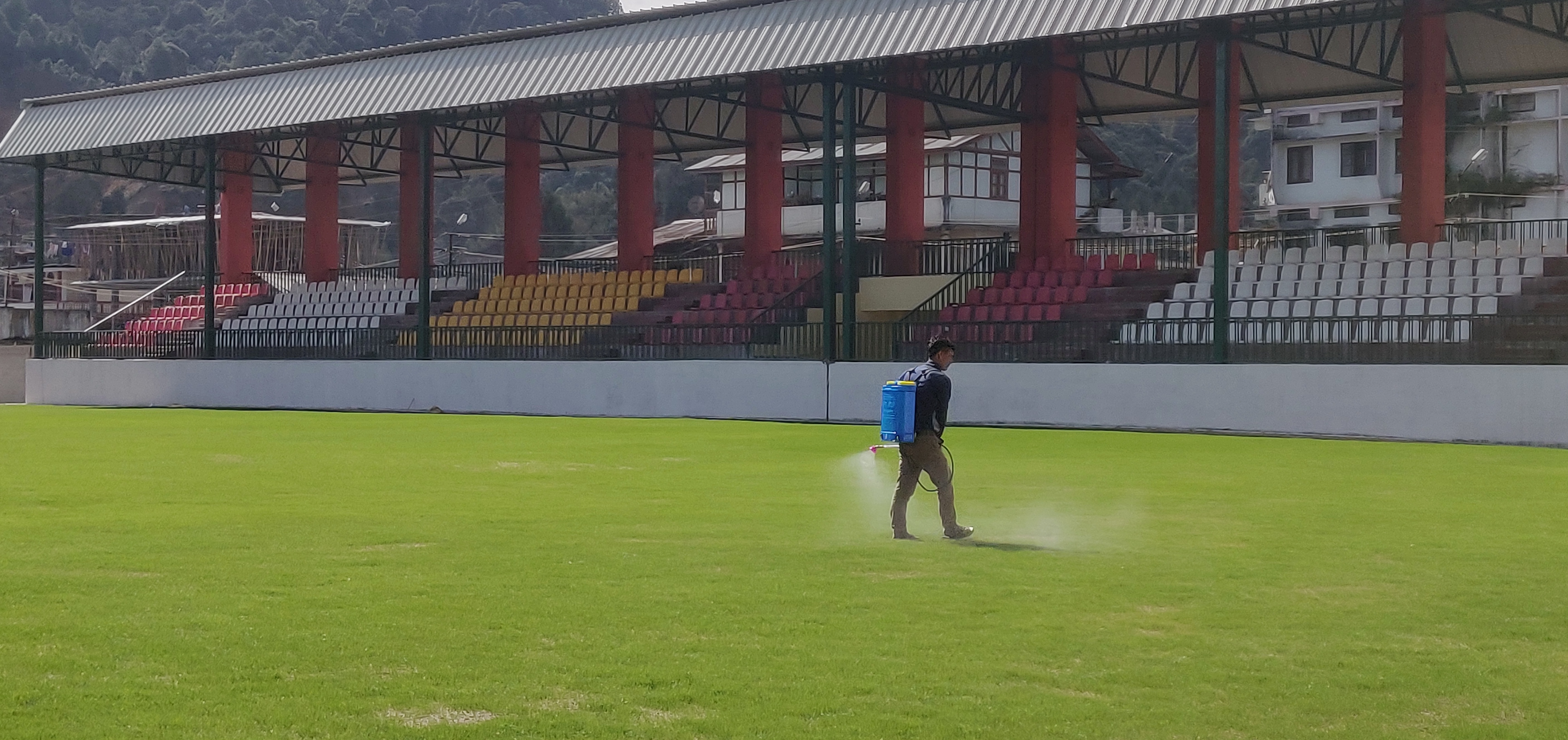
Turf spraying operations on a natural grass sports field

Our team consists of highly skilled professionals with their background, knowledge and experience gained from every corner of the world, from surveying & design, planning stage, earthmoving, grading, construction, drainage/irrigation & finishing, seeding, grassing, grow-in maintenance for the following types of facilities:

FOOTBALL/ RUGBY/ POLO GROUND

Our Sports Field Maintenance Process

Step 1: Baseline Site Assessment

All contracts start with a baseline assessment of the field micro-climate, existing levels of compaction and the effectiveness of drainage.

Step 2: Sub-surface Soil & Turf Testing

Our team conducts thorough lab testing of soil pH, organic matter, nutritional deficiencies & water retention properties.

Step 3: Customised Maintenance Plan Design

We will create a customised seasonal calendar, including custom aeration, topdressing and nutrient inputs based on the data collected during the testing phase.

Step 4: Specialist Crew Deployment

Our groundsman, machinery specialists and tournament level maintenance equipment will be brought to the field.

Step 5: Regular Monitoring & Reporting

We constantly test soil moisture, analyse tissue and monitor performance, which allows us to adapt our strategy flexibly to changing weather patterns.

Agronomy Requirements for Football / Rugby / Polo Pitch

To be successful with the player demand, each of these sports formats needs a very different agronomic approach:

Football Pitches

Need an ideal mix of sand and soil sub-base to create a flat surface that ensures even ball roll, quick water drainage and a level root zone that helps protect players from sudden ankle injuries.

Rugby Grounds

Must endure scrummaging and heavy impacts with turf shear strength and heavy wear resistance. Agronomists stress deep-tine aeration and establishment of dense, aggressive grasses that recover quickly from heavy divoting.

Polo Grounds

They have much larger turf areas than standard fields, and therefore require specialised wide-area reel mowers. Heavy horse hooves can cause compaction or pull away the underlying soil profile, therefore cutting heights need to be adjusted very carefully.

Why Choose GreenLinks

We apply the rigorous agronomic standards of championship field facilities where millimetres matter to stadium outfields, football pitches and multi-sports surfaces.

On Call Certified Agronomists & Ground Staff

Our operations are ready and monitored by credentialed sports turf specialists with over 15 years of technical research and field experience.

PAN INDIA Presence

With a large PAN INDIA logistics and technical setup we are able to deploy resources and consult quickly, irrespective of regional soil compositions or extreme local climates.

Eco-Friendly and Sustainable Mindset

We follow integrated pest management (IPM) and integrated nutrient management (INM) to help reduce the application of turf chemicals with an emphasis on environmental safety and water-use efficiency.

Sports Field Maintenance Assessment

Is your athletic turf plagued by bare spots, poor drainage, or inconsistent player traction? Contact us today for a full turf analysis of your property. Our agronomists will visit your field to assess the soil conditions, drainage and the health of the turf. Based on this they will provide you with an actionable & customised maintenance blueprint or a quote for an Annual Maintenance Contract (AMC).

Request a Turf Assessment

More Services

Frequently Asked Questions

Sports field agronomy is the science and practice of managing turfgrass health on a sports ground, covering soil condition, fertilization, irrigation, mowing, and pest control to keep the playing surface safe and consistent. It's distinct from one-time construction; agronomy is the ongoing discipline that keeps a field performing well for years. GreenLinks offers Sports Field Agronomy & Maintenance as a dedicated service covering agronomic and water standards, maintenance standards, and field set-up for football, rugby, and polo grounds. A common mistake is treating agronomy as basic lawn care rather than a specialized discipline requiring trained agronomists.

Sports field maintenance covers everything needed to keep a built field safe and playable: mowing and field set-up, agronomic and water standards for turf and irrigation, maintenance standards for pitches and overrun areas, equipment upkeep, and safety/security procedures. GreenLinks structures its Sports Field Agronomy & Maintenance service around these exact areas, along with staffing, staff training, and hazardous material management. Facilities that treat maintenance as "just mowing" often miss drainage checks, equipment servicing, and chemical handling protocols, all of which affect field safety and turf lifespan over time.

Maintenance costs vary by field size, grass type, usage intensity, and whether the work is done in-house or contracted through an Annual Maintenance Contract (AMC), so there's no fixed nationwide figure. Natural grass fields generally cost more to maintain than synthetic turf because of mowing, fertilization, irrigation, and agronomic labor, but they also don't carry the eventual carpet-replacement cost synthetic surfaces do. GreenLinks does not publish fixed AMC rates since scope and site conditions differ; the accurate way to budget is a site assessment through its Sports Field Agronomy & Maintenance service.

Mowing frequency depends on grass type, season, and growth rate, but during active growing periods, warm-season grasses common on Indian football and rugby grounds typically need mowing multiple times a week to stay dense and wear-tolerant. GreenLinks includes mowing under Field Set Up and Maintenance in its agronomy service. Mowing too infrequently or cutting too short both weaken turf density, making the field more vulnerable to wear and injury-causing unevenness.

The most frequent mistakes are mowing too short or irregularly, skipping aeration and topdressing, over- or under-watering due to poor irrigation monitoring, neglecting equipment maintenance, and treating safety/chemical handling as optional. GreenLinks structures its Sports Field Agronomy & Maintenance service specifically around these areas, maintenance standards, agronomic and water standards, equipment maintenance, and hazardous material management, to prevent them. Left uncorrected, these mistakes compound: poor irrigation weakens turf, which then can't recover from mowing stress, accelerating overall field decline.

An under-maintained field typically shows thinning or bald turf patches, uneven surfaces from compacted soil, poor drainage response after rain, and increased injury risk from an inconsistent playing surface. These problems compound over time; a field that's neglected for a season or two often needs renovation rather than simple upkeep to recover. GreenLinks' Sports Field Agronomy & Maintenance service exists to prevent this decline through structured, ongoing care rather than reactive fixes after problems appear.

An AMC is a formal agreement where a provider takes ongoing responsibility for a sports field's maintenance, mowing, agronomy, irrigation, equipment care, and safety compliance, for a fixed annual scope, rather than one-off callouts. This structure is common across Indian infrastructure maintenance generally and applies directly to sports grounds. GreenLinks' Sports Field Agronomy & Maintenance service covers the full scope an AMC would typically include: staffing, agronomic standards, equipment maintenance, and hazardous material management. Facilities without a formal AMC often see inconsistent care and reactive, more expensive repairs.

It depends on your facility's scale and in-house expertise. In-house staff can work if they're properly trained in agronomy, equipment care, and safety protocols, all areas GreenLinks includes in its own staff training scope, but many facilities lack agronomists or safety-trained crews internally. An AMC with a specialist consultant brings structured standards, trained staff, and accountability in one contract, which usually costs more than basic in-house mowing but prevents the turf decline and safety issues that come from inconsistent, under-qualified care.

GreenLinks was founded in 2007 as a golf industry consultancy and has since built a dedicated Sports Field Agronomy & Maintenance service alongside its Golf Agronomy & Maintenance offering, applying the same agronomic expertise, root-zone science, irrigation management, turf health, to football, rugby, and polo grounds. Its team includes certified agronomists, horticulturists, and greenkeepers who work across both golf and sports field projects. This shared expertise means the same rigor applied to golf greens carries over to sports field turf management.

Natural grass generally requires more ongoing labor, mowing, fertilizing, irrigating, and aerating, than artificial turf, which mainly needs brushing, debris removal, and periodic infill top-ups. However, artificial turf isn't maintenance-free either, and its sub-base and drainage still need attention over its usable life. GreenLinks specializes in natural grass agronomy and maintenance for football, rugby, and polo grounds, where the trade-off for higher maintenance involvement is typically better ball roll, player comfort, and lower installation cost.

India’s climates are so varied that a very flexible agronomy is needed. The fields are at the risk of heavy water logging, nutrient leaching and severe fungal pressures in the intense summer monsoon. We are now looking at aggressive sub-surface aeration, preventative anti-fungal treatments and adjusting fertiliser inputs to stop rapid, weak growth.

Northern winters, however, either dormant or slowed the growth of turf. During this time of year we vary our mowing frequency, limit heavy mechanical compaction and use timed micro-nutrients to protect root health until the spring grow-in period begins.

Copyright © 2023-25 GreenLinks Consulting LLP. All rights reserved | Sitemap | Developed By OptMum Digital.